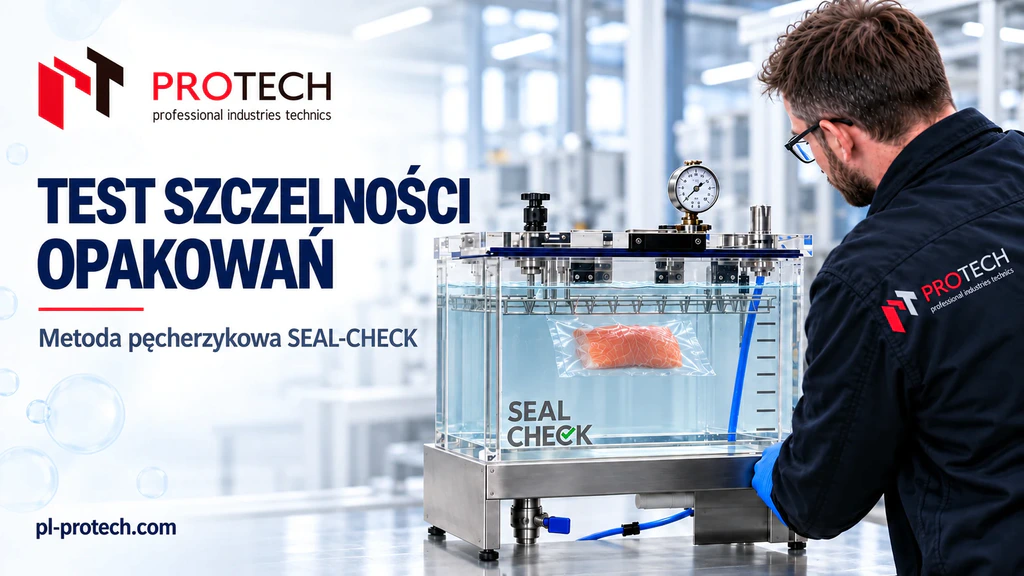
The vacuum bubble test allows you to detect and locate packaging leaks by observing the gas escaping into the water.
The vacuum bubble test detects and locates package leaks by observing gas escaping into the water. The package being tested is placed in a chamber where the pressure is reduced. For a quality control technician, it's crucial to distinguish between three observations: package swelling, bubble leakage, and the absence of visible leakage. We explain how to interpret these signals using SEAL-CHECKpneumatic tester as an example.
Author: PRO-TECH
In short
- Packaging swelling may be due to gas expansion; it does not in itself indicate a leak.
- Bubbles emerging from the damaged area help locate the leak.
- The absence of visible bubbles must be assessed within the limits of the method used and the test parameters.
- The vacuum pressure and observation time are selected according to the packaging, device instructions and quality control procedure.
Contents
- How does the vacuum bubble test work?
- How does the test work in the SEAL-CHECKtester?
- How to interpret the result?
- How to choose negative pressure and observation time?
- Can MAP and vacuum packaging be tested?
- How to maintain comparable conditions for subsequent tests?
- Hypothetical example: leaking MAP tray seal
- Questions about the scope of the study
How does the vacuum bubble test work?
The bubble test exploits the pressure difference between the interior of the package and the surrounding chamber. As the pressure around the submerged package decreases, the gas within it can expand. The flexible package can then increase in volume, or swell.
If gas escapes through a leak, bubbles appear in the water. Observing where they emerge can help pinpoint a damaged section of the seal or packaging surface. This is the principle behind SEAL-CHECKleak testers described in the source material.
In this configuration, compressed air powers the pneumatic vacuum system. The operator adjusts the pump's supply using a knob and reads the vacuum on the chamber's vacuum gauge. The supply pressure gauge and the vacuum gauge show values for different parts of the system, so it's important to distinguish between the two readings during testing.
The SEAL-CHECK card describes the compressed air-powered Venturi system and vacuum control. Before starting work, please check your device's configuration and instructions.
How does the test work in the SEAL-CHECKtester?
The test includes sample preparation, vacuum generation, observation, and test completion. The following description explains the sequence of steps for the setup presented in PRO-TECHmaterial. Detailed device operation is described in the manual for the specific model.
Safety: The tester must be operated by trained personnel in accordance with the manufacturer's instructions and applicable plant policies. The lid may only be opened after the chamber has been completely pressurized.
- Preparing the device and sample. The device is connected to the compressed air system according to the manufacturer's requirements. The container is placed in a chamber with the appropriate amount of water and the lid is closed. Sample preparation should be consistent with the adopted test procedure.
- Activating the vacuum. The operator activates the pneumatic system using the control lever. The pump lowers the pressure in the chamber, and the vacuum gauge allows you to monitor the pressure change.
- Achieving test parameters. The controller sets the conditions required for the procedure. The observation time refers to the moment indicated in the procedure; closing the lid alone does not confirm that the required vacuum has been achieved.
- Observe the packaging. The operator checks for bubbles and determines their source. Separately, the operator records the change in the packaging's shape and the leak observation result.
- Completion of the test. After observing, the operator terminates the test and equalizes the pressure according to the device's instructions. Once the pressure is completely equalized, the operator opens the lid, removes the sample, and records the result.
How to interpret the result?
The test result should describe what was observed under specific parameters. Simply increasing the package volume is not sufficient to determine a leak. The basis for leak assessment is observing the gas escaping from the package.
The table helps separate the observation from the conclusion and subsequent decision. The criteria for accepting or rejecting a sample are defined by the facility's procedure.
| Observation | What can be concluded? | What doesn't the result decide? | The next step |
|---|---|---|---|
| The packaging is swelling | The change in shape may be due to the expansion of the gas | Swelling alone does not confirm a leak. | Continue observation according to procedure |
| Bubbles flow out from a specific part of the weld | Visible gas leakage indicates the location of the leak under test conditions. | Observation does not determine the cause of the weld defect. | Record the leak location and test results. |
| Bubbles emerge through the surface of the foil | The gas leak can be located outside the weld | The result does not indicate the stage at which the damage occurred | Document the location and submit a sample for evaluation |
| No bubbles observed | No visible leakage was detected under the conditions used. | The result does not rule out all leaks | Evaluate the sample according to the criteria and scope of the method |
The official description of ASTM D3078-02(2021)e1—Standard Test Method for Determining Leaks in Flexible Packaging by Bubble Emission— addresses the detection of larger leaks in flexible packaging containing gas. It also notes that small leaks can go undetected and the product can block the leak path. Therefore, the absence of bubbles does not provide an absolute guarantee of leak-tightness. Source: ASTM International.
The description of the test mechanism does not replace documentation of compliance of the entire procedure with the standard. Such compliance should not be inferred solely from the name of the device or a similar method of operation.
How to choose negative pressure and observation time?
The vacuum and observation time should be determined for the package being tested using the specific model's instructions and an approved quality control procedure. One setting does not automatically apply to all films, seals, and products.
The PRO-TECH material indicates that the selection of parameters depends on the type, design, and strength of the packaging. Therefore, any change in format or packaging method requires verification of whether the current test conditions are still applicable. Vacuum gauge readings should be compared to the requirements specified in the procedure.
In practice, before launching a series of tests, it's necessary to know the answers to three questions: what vacuum pressure to use, how long to observe, and what criteria to use to evaluate the sample. Simply reaching the technical limits of the device doesn't determine the proper conditions for packaging inspection.
Can MAP and vacuum packaging be tested?
The test's usefulness depends, among other things, on the amount of gas inside the package. In MAP (modified atmosphere) packages, this gas is a protective mixture. Under pressure differences, it can expand and escape through a leak into the surrounding water.
Some vacuum packages contain very little gas. The provided description of SEAL-CHECK operation clearly indicates that the effectiveness of the bubble method may be limited in such cases. Before applying the test to such a package, its suitability for the expected inspection scope must be confirmed.
Therefore, it's worth starting the tester selection with the sample and the purpose of the test. The type of packaging, the product, and the location where the operator will observe a potential leak are all important factors.
How to maintain comparable conditions for subsequent tests?
Comparing results requires parameter control and a clear record of observations. According to the PRO-TECH description, for subsequent tests with the same requirements, the regulator setting can be left unchanged and the vacuum applied using the lever. This simplifies operation, but the actual test conditions must still be verified using a vacuum gauge.
The following list may be used to assist in preparing the audit record:
- sample and batch designation;
- type of packaging and packaging method;
- tester model;
- required and observed negative pressure;
- time of observation and the moment of starting its counting;
- result, location of possible leak and person performing the test.
This suggested field should be adapted to the facility's documentation. It helps to link the sample evaluation to the conditions under which it was generated.
When selecting a device, it's also important to consider the packaging format and chamber space. PRO-TECH offering includes the tabletop SEAL-CHECK TypeA and SEAL-CHECK Type 2B models. Model selection should be based on the sample dimensions and the device's documentation.
Hypothetical example: leaking MAP tray seal
The following example is hypothetical and serves to clarify the interpretation of the result.
Let's assume an operator is testing a tray sealed with foil in a modified atmosphere using a SEAL-CHECK tester. Using parameters established for this packaging in the company's procedure, the foil lifts slightly when the pressure is released, and then bubbles begin to emerge from one corner of the seal.
The operator records two separate observations: a change in the foil shape and a gas leak at the corner of the tray. The latter indicates a leak under the conditions of this test. The lifting of the foil itself could be due to the expansion of gas trapped within the package.
This result helps direct further evaluation to the indicated section of the seal. However, it does not allow for the independent determination of whether the defect occurred during the sealing process or whether the packaging was damaged later. In this scenario, the quality department decides how to proceed with the sample in accordance with the established procedure.
Questions about the scope of the study
Does the bubble test measure the strength of the seal?
No. The test described here is intended to observe the leak and its location under the conditions used. It does not provide a measurement of the force required to break the weld.
Does the leak detection indicate the cause of the problem at the welding machine?
No. Observation helps pinpoint the location of the leak. Determining the cause requires a separate evaluation of the sample and the packaging process.
Does the result of one sample confirm the tightness of the entire batch?
No. The result refers to the package tested and the conditions used. Sampling guidelines and batch decisions are determined by the quality control plan.
Is the regulator setting sufficient to compare two tests?
No. The actual vacuum, observation time, and sample type must be taken into account. Leaving the knob in the same position simplifies operation but does not document all test conditions.
What is worth remembering?
The vacuum bubble test helps detect and locate package leaks. Accurate assessment requires distinguishing between swelling, visible gas leakage, and no detected leak. The significance of the result depends on the suitability of the method for the specific package and the test conditions. These conditions should be specified in the instrument's instructions and quality control procedures.
Need a SEAL-CHECK tester for your packaging? Prepare its dimensions, material type, and packaging method, then contact PRO-TECH.
About the author
PRO-TECH supplies parts and equipment for industry and provides maintenance services. The company offers SEAL-CHECKpackaging leak testers.
Need help choosing or a quote?
We'll help you choose the right part or solution for your machine. Call or write to us — we advise based on real hands-on maintenance experience.